
KfW and Sustainable Development Goals (SDGs)
Global challenges such as increasing global warming, the coronavirus pandemic, social crisis and international conflicts shape social and political discourse. They highlight the urgent need to drive the transition to a sustainable society. Against this background, the United Nations General Assembly adopted the Agenda 2030 with the Sustainable Development Goals (SDGs) at the UN Summit on Sustainable Development in September 2015.
As one of the world's leading promotional banks, KfW supports these 17 goals for environmentally, economically and socially sustainable development. These efforts reinforce the bank's claim to be a pioneer in shaping the transformation towards a better, more climate-friendly and more sustainable world. Based on its mandate as a promotional bank of the German Federal Government and the German federal states, KfW has been supporting the sustainable improvement of living and economic conditions for more than seventy years.
KfW manages its business on the basis of key megatrends: climate and environmental protection (SDG 6, 7, 12, 13, 14, 15 and others), digitalization and innovation (SDG 9 and others), social change (SDG 4, 10 and others) and globalization (SDG 7, 8, 9 and others). As a “responsible bank”, KfW Group contributes to meeting all SDGs by promoting and financing countries, municipalities, companies and private individuals in Germany, Europe and around the world. Since no international standards have been established to date with view to reporting SDG-contributions in the financial sector, KfW has developed its own group-wide SDG mapping. KfW is thus transparent about which positive SDG contributions can be expected from its new commitments every year.
The contribution of KfW Group to the SDGs1, 2
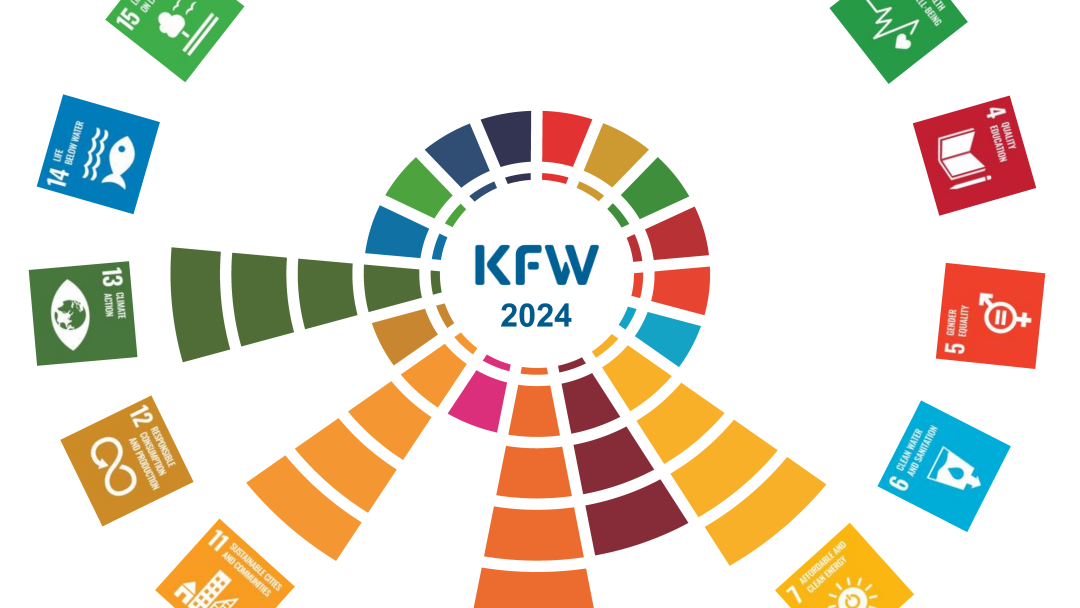
1 KfW's financing generally contributes to several SDGs at the same time.
2 The SDG mapping depicted was adjusted for special effects from mandated transactions amounting to 1 billion EUR in FY 2025 and 8.5 billion EUR in FY 2024 to stabilize and secure energy supply in Germany, which were carried out on behalf of the German government.
KfW Group contributes to all 17 SDGs. Our focus on promotion and financing is reflected in the SDG mapping. KfW makes the biggest contributions to
- SDG 7 – Affordable and Clean Energy
- SDG 13 – Climate Action
- SDG 8 – Decent Work and Economic Growth
- SDG 11 – Sustainable Cities and Communities
KfW is a pioneer in the banking sector with its volume-based SDG mapping. KfW largely updates its annual SDG mapping automatically on the basis of the new commitments made the previous financial year.
SDG mapping of KfW Group
*The SDG mapping depicted was adjusted for special effects from mandated transactions amounting to 1 billion EUR in FY 2025 and 8.5 billion EUR in FY 2024 to stabilize and secure energy supply in Germany, which were carried out on behalf of the German government.
Share page
To share the content of this page with your network, click on one of the icons below.
Note on data protection: When you share content, your personal data is transferred to the selected network.
Data protection
Alternatively, you can also copy the short link: https://www.kfw.de/s/ennBhLPY
Copy link Link copied