
Tip: Activate javascript to be able to use all functions of our website
Tip: Activate javascript to be able to use all functions of our website

Conserving and restoring biodiversity is one of the most urgent tasks of our time – and we can only succeed, if we act together and decisively. As a digital transformation and promotional bank, KfW assumes responsibility and actively contributes to preserving the natural foundations of life. Already today, with an active portfolio of around EUR 4.5 billion, it is among the largest financiers of biodiversity conservation worldwide and, on behalf of the German Federal Government, it supports more than 800 protected areas in around 70 countries. This engagement is based on the “Law Concerning the Kreditanstalt für Wiederaufbau”, which explicitly mandates KfW to promote environmental protection.
Life on earth without biodiversity is inconceivable. Yet human-induced biodiversity loss has been accelerating for decades. We still have the opportunity to stop this trend - and even reverse it. However, this requires rapid, ambitious and coordinated efforts. The signatory states of the Kunming-Montreal Global Biodiversity Frameworks set a clear goal: a world of life in harmony with nature. At KfW, we are convinced that every contribution counts – together we can make a real difference and contribute to achieving the goal.

KfW Group aims to lay the foundation for actively contributing to the recovery of biodiversity and to living in harmony with nature by 2050. To this end, KfW initiated the bioSFer project – an endeavour that we started at the beginning of 2023. With the KfW Biodiversity Roadmap, we laid the foundations in 2024. Building on this, we are gradually developing our group-wide biodiversity strategy, guided by the action targets of the Global Biodiversity Framework (GBF) up to 2030. From the outset, we focused on a cross-departmental, interdisciplinary team to address the topic with a holistic perspective. In doing so, we deliberately take both impact directions into account: through the projects we finance, our business activities can have positive effects on biodiversity, but – for example in the case of infrastructure projects – potentially also unintended negative effects. At the same time, the bank itself depends on intact ecosystem services.
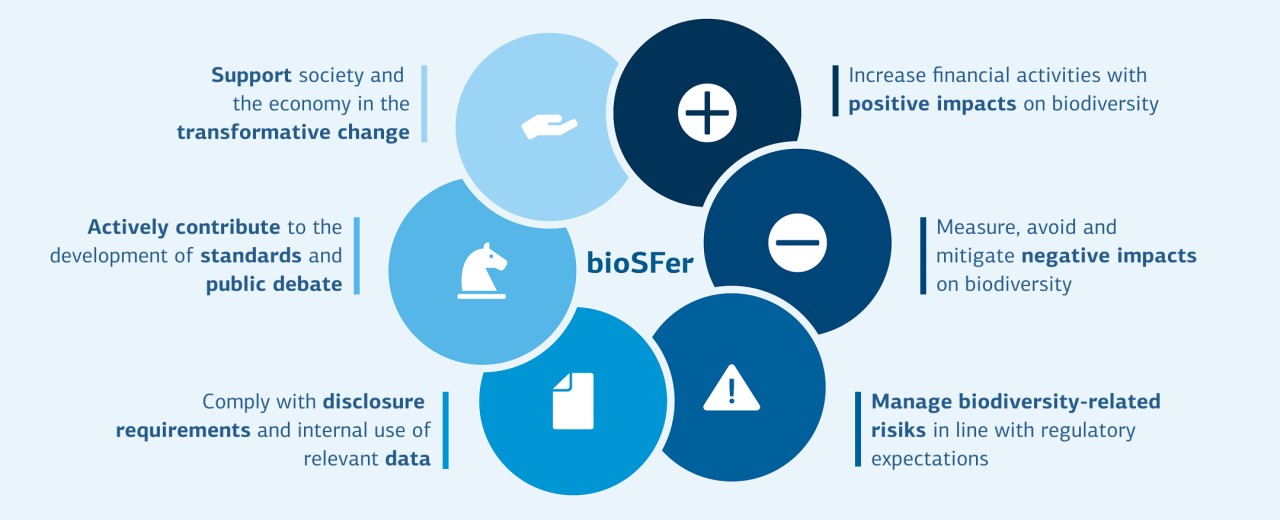
To develop our biodiversity strategy, we focus on the following dimensions:
These dimensions are currently being analysed and addressed in separate work packages. Together, they form the basis for our group-wide biodiversity strategy, which is currently being developed. For the “positive impact” dimension, we are building on existing approaches to develop a methodology that allows us to classify the contribution of projects to biodiversity. We already address negative impacts through established processes: a group-wide exclusion list and the environmental and social impact assessment (ESIA), which follows the mitigation hierarchy – avoiding negative impacts before minimisation, restoration and compensation.

Where does the project name bioSFer come from?
The name bioSFer derives from the planetary boundary concept “Biosphere Integrity”. It describes the critical state of biodiversity and the urgency of protecting and restoring biodiversity – whereby the biosphere encompasses the entire system of all ecosystems. The capital letters SF in the middle of the word highlight the project’s integration into the Sustainable Finance concept of KfW Group. Thus, bioSFer combines ecological urgency with the financial sector’s strategic responsibility.
What is special about KfW’s approach to developing the biodiversity strategy?
What makes our approach special is the multidisciplinary perspective on the topic. We look at all key aspects – from positive impacts and avoiding negative impacts, to risks and dependencies. In addition, we aim to increase our positive contribution to the conservation of biodiversity by actively helping to shape the public debate and, not least, by supporting society and the economy in the transition process.
What role does the Global Biodiversity Framework play in the development of the biodiversity strategy?
The Global Biodiversity Framework adopted at the 15th Conference of the Parties of the Convention on Biological Diversity in Montreal aims to stop biodiversity loss and reverse it by 2050 – to enable life in harmony with nature. To this end, both a long-term vision by 2050 and targets by 2030 were defined. We at KfW Group also support the targets and vision and wish to make an active contribution with our own biodiversity strategy.
Detailed information on the approach to a biodiversity strategy can be found in the KfW Group's bioSFer paper:
We also explain our approach to protecting, conserving and restoring biodiversity in the following publications:
Share page
To share the current page content with your network, click the button below and then select the desired option in the dialog box.
Note on data protection: By clicking the button, your browser's sharing function is used. If you select an external provider when sharing, personal data may be processed by the provider. Please read our data protection principles for more information.
Your browser does not support sharing with external services.
Alternatively, you can also copy the short link: https://www.kfw.de/s/ennB8ake
Copy link Link copied