
Tip: Activate javascript to be able to use all functions of our website
Tip: Activate javascript to be able to use all functions of our website

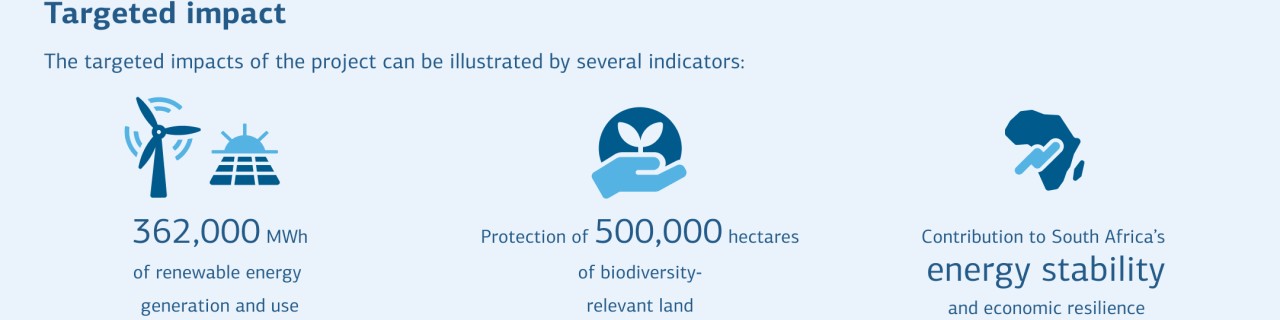
South Africa is facing major challenges: An unstable energy supply is holding back economic development, while climate change is threatening valuable ecosystems. DEG – Deutsche Investitions- und Entwicklungsgesellschaft supports a just transition in cooperation with its long-standing client, South Africa's FirstRand Bank.
South Africa has been suffering from a persistent energy crisis for years. In some regions, power cuts can last for up to twelve hours a day. The consequences range from production losses and job cuts to social tensions. At the same time, the country is heavily dependent on coal, making it one of the largest CO₂ emitters in Africa.
Together with European partners, DEG has been active in South Africa for many years to support a socially balanced transformation of the energy sector. A key element is cooperation with strong local financial institutions such as South Africa’s FirstRand Bank, which enables investments in renewable energy, energy efficiency and climate-related infrastructure. In 2025, DEG mobilised a financing package of USD 300 million for FirstRand Bank — including a DEG share of USD 100 million — to enable investments in climate resilience.
“A stable and reliable energy supply is an important prerequisite for economic development and social progress,” explains Abbad El-Rayyes from DEG Impulse. The DEG subsidiary is implementing the project under the develoPPP programme with funding from the German Federal Ministry for Economic Cooperation and Development (BMZ). “Our goal is to promote investments in the transition to renewable energy through financial support for FirstRand Bank.”
As part of the develoPPP project, DEG Impulse supports FirstRand Bank in accompanying its clients in their investments in renewable energy. This includes advisory services for commercial clients as well as strengthening internal expertise in sustainable finance. In addition, new frameworks for environmental impact bonds and water certificates are to be developed to mobilise private capital for climate and nature conservation.
Another priority is on financing structures that combine public funds and private capital. Such approaches can help mitigate risks, incentivise investment and close financing gaps in areas that are particularly important for a just transition. These measures are embedded in the Just Energy Transition Partnership – an agreement concluded between the G7 countries and South Africa at the 2021 UN Climate Change Conference in Glasgow to support a just transition towards a climate‑neutral energy supply.
A key feature of the project is the systematic measurement and management of development impact. “We combine two perspectives: DEG’s internal Development Effectiveness Rating DERa 2.0 and, in addition, the BMZ impact logic,” explains Dr Miriam Amine from DEG Impulse.
DERa 2.0 considers both the development effects of clients – for example in terms of employment, income or environmental aspects – and the transformation processes triggered by DEG’s financing and advisory services. The findings feed into investment decisions as well as into the further development of projects.
The complementary systematic assessment of development cooperation by BMZ also makes it possible to trace which objectives have been set and how input, output, outcome and impact – i.e. the development value added – are interlinked. This allows for a transparent presentation of how financial and human resources as well as knowledge and expertise jointly contribute to measurable development impact.
The project aims to contribute to several of the United Nations Sustainable Development Goals (SDGs), covering economic, social and environmental dimensions:
The development impact report presents DEG’s results and achievements and its contribution to the United Nations Sustainable Development Goals.


Share page
To share the current page content with your network, click the button below and then select the desired option in the dialog box.
Note on data protection: By clicking the button, your browser's sharing function is used. If you select an external provider when sharing, personal data may be processed by the provider. Please read our data protection principles for more information.
Your browser does not support sharing with external services.
Alternatively, you can also copy the short link: https://www.kfw.de/s/ennCAoax
Copy link Link copied