
Tip: Activate javascript to be able to use all functions of our website
Tip: Activate javascript to be able to use all functions of our website
Despite years of stagnation, Germany has realistic potential for significantly more growth in the long term. The KfW Research study entitled “A hub for the future. How Germany will find new strength and growth” (Standort Zukunft. Wie Deutschland zu neuer Stärke und Wachstum findet) has found that potential annual growth of more than one per cent is achievable in the coming decade. Since 2015, this growth has fallen from just under two per cent to little more than zero. A sustained upswing is contingent on Germany strengthening the three key forces of growth – labour, capital and productivity – in a targeted manner.
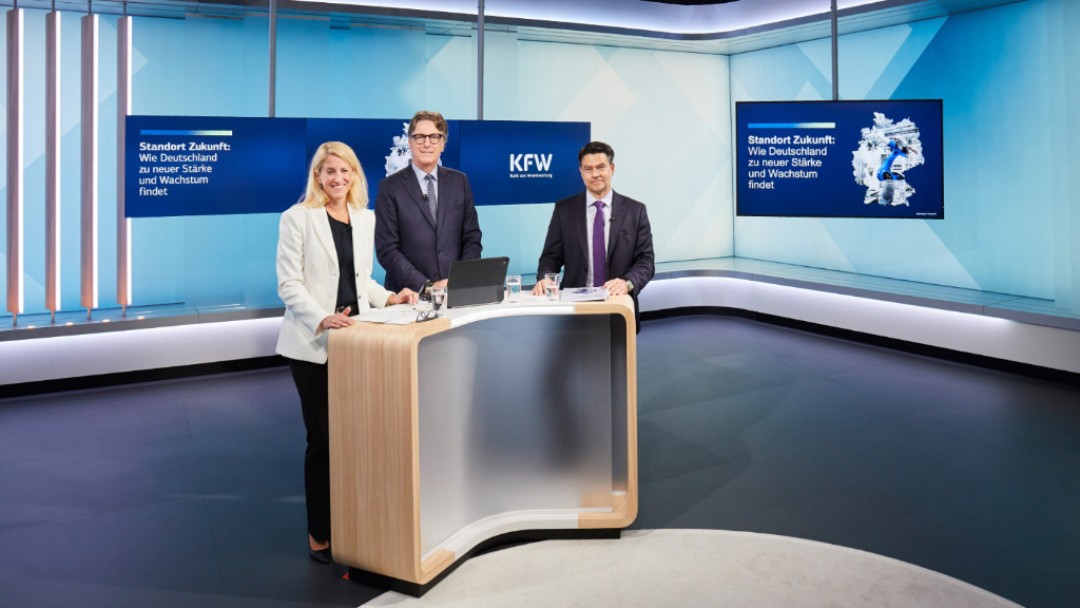
The following theses categorize areas of economic activity identified in the KfW Research study “A hub for the future. How Germany will find new strength and growth”. They do not constitute a list of political demands by KfW, but rather a contribution to the debate on the future of Germany as a business location.
Productivity is the central lever for increasing potential growth, but only in conjunction with labour and capital. Productivity determines how much prosperity can be generated with a limited workforce, increasingly scarce resources and substantial investment requirements. Going forward, Germany will no longer be able to safeguard its prosperity primarily through a growing workforce and the strength of individual export industries such as automotive and mechanical engineering. The working-age population will shrink, while the number of people of retirement age is set to increase. This makes it increasingly important to achieve more with the labour and capital available. The extent of the pressure to act is evident from the trend in potential growth: Since 2015, it has fallen from just under two percent to close to zero.
Productivity is more than just an economic indicator. It reflects the degree to which human labour, machinery, knowledge and technology are combined. New software, a more efficient production process, better logistics and the use of artificial intelligence (AI) can significantly increase the output of the same workforce and equipment.
This is precisely why productivity represents the greatest opportunity for growth. However, digitalisation and AI will not deliver these benefits on their own. They need to be adopted by businesses and the public sector, integrated into workflows and supported by training, investment and high-performing infrastructure. The goal is not a handful of flagship projects, but widespread adoption. In the KfW Research scenario, average real potential growth of more than one percent could be achieved between 2030 and 2040 if the conditions for employment, investment and productivity continue to develop in the right direction. Productivity will need to make the largest additional contribution.
Three key levers
1. Broad application: Digital technologies, particularly AI, need to be integrated with all due haste into the workflows of as many companies as possible.
2. Qualification: Training in digital skills enables these technologies to be used in day-to-day work settings.
3. Investment in machinery, research and digital infrastructure delivers lasting productivity gains.
Ultimately, economic growth is determined by the interaction of the three factors of production: labour, capital and productivity. Momentum across all three has weakened significantly in recent years. Germany therefore needs a compelling strategy for sustained growth that makes it easier to invest, mobilises labour and accelerates technological renewal. These three factors need to overlap. Focusing on just one of these factors would not be sufficient in scope. The scale of the challenge becomes clear from two long-term trends: Annual working hours per employed person fell from around 1,530 hours in 1995 to just over 1,330 hours in 2025. Meanwhile, the investment rate declined from 22 percent of GDP in 2000 to 19.6 percent in 2025.
The volume of labour remains important. Equally important is investment in machinery, buildings, networks, research and digital systems. Productivity can make both of these factors more effective and enable growth even when the workforce is no longer expanding. That is encouraging, because this is a process that can be actively shaped and Germany does not need an economic miracle. As the KfW Research scenario shows, average real per capita growth of at least one percent is achievable once again.
Three key levers
1. Mobilise labour: More people should be able to work and remain in employment for longer.
2. Mobilise capital: When private and public investments complement each other effectively, they create the foundation for future value creation.
3. Increase productivity: Technological progress and innovation make labour and capital more productive.
Investment today lays the foundation for competitiveness and growth tomorrow. In Germany, however, this has been limited for years now. Companies face weak demand prospects, high energy and labour costs, uncertainty, a significant bureaucratic burden and a foreseeable shortage of skilled workers. The willingness to invest remains relatively low, particularly among small and medium-sized businesses. At the same time, demographic change is making business succession increasingly challenging in many sectors. Between 2019 and 2025, business investment fell by 8.3 percent after adjusting for price and calendar effects. Averaged over the past four quarters, it accounted for just 10.9 percent of gross domestic product, a level previously seen only during the global financial crisis.
Companies do not invest because the government wants them to; they invest when a project makes economic sense and the risks can be reliably assessed. Policymakers cannot make these decisions for them. However, policymakers can indeed improve the conditions for investment through clear, long-term frameworks, faster approval processes, reliable funding instruments and better access to debt, mezzanine and equity capital. Even a return to the long-term average, with business investment as a share of GDP rising by one percentage point, could increase potential growth by 0.1 to 0.2 percentage points over an extended period.
The additional scope created by the government’s investment initiative must provide an initial impetus during the current period of weakness. What matters is that the funds are deployed quickly, represent genuinely additional investment and reach areas where they can complement private investment and enable new value creation. Whether and how such instruments are used is ultimately a political decision.
Three key levers
1. Predictability: Clear and stable long-term frameworks and faster approval processes reduce investment risks.
2. Financing: Debt, mezzanine and equity capital must be available for viable projects.
3. Additionality and speed: Public funds must be deployed quickly, complement private investment and generate new value creation.
Many of the largest investment gaps are in public infrastructure, particularly at the municipal level. Schools, roads, public transport, digital networks and electricity and heating infrastructure are far from secondary concerns. They play a crucial role in determining whether companies can develop their sites, attract skilled workers and adopt new technologies. In 2025, the investment backlog reported by municipalities stood at EUR 231 billion, of which EUR 69 billion related to schools and EUR 54 billion to roads and transport.
Public investment creates demand while also increasing the economy’s productive capacity. Well-planned infrastructure stimulates private investment by improving the potential returns for businesses. The quality of the funds used is therefore crucial. Clearly prioritising projects that support growth is the key prerequisite. Drawing together the various estimates, the KfW Research study “The location of the future: How Germany can regain its strength and achieve growth” puts additional public investment needs at a total of EUR 400 to 600 billion over the next ten years, equivalent to EUR 40 to 60 billion annually. Empirical studies for Germany have found that each additional euro of public investment increases the gross domestic product by a cumulative total of more than one euro and, under favourable conditions, by around two euros.
Promotional banks such as KfW make an important contribution to this process within the scope of their statutory mandate. They share risks and bridge financing gaps where the market alone cannot provide sufficient funding. Funding instruments should be designed to complement the market, mobilising private capital while avoiding crowding out private investment. This applies to companies as well as municipalities, municipal utilities and transformation projects.
The design and financing of funding instruments and their distributional effects are matters for policymakers. For KfW, what matters is that these instruments are deployed transparently, on a subsidiary basis and in a way that complements the market. One example is the Germany Fund, launched at the end of 2025 and jointly established by the Federal Government and KfW, which mobilises private capital in key areas for the future: small and medium-sized businesses, energy supply, start-ups and scale-ups. This includes, for example, major investments in new technologies and production facilities, the expansion of renewable energy, heating networks and electricity grids, as well as the extraction of raw materials and the financing of innovative technologies such as deep tech, AI and biotech, together with the development of solutions to strengthen defence capabilities. The Federal Government is providing public funds and guarantees amounting to around EUR 30 billion. This is intended to trigger investments totalling around EUR 130 billion – as an investment campaign alongside state special funds.
Three key levers
1. Prioritisation: Prioritise infrastructure funds for growth-relevant projects.
2. Leverage: Public financing should share risks and mobilise private principal, not displace it.
3. Implementation: Municipalities and companies need broad, reliable access to financing and private capital.
Bureaucracy is not an abstract cost factor. It ties up time, money and skilled workers. Lengthy approval processes delay investment, complex funding requirements place an excessive burden on smaller companies, and municipalities and conflicting regulations place a brake on innovation. The impact of this burden becomes particularly clear when we look at business start-ups: In 2025, founders spent an average of more than five hours a week dealing with statutory and regulatory requirements. For those starting a business as their main occupation, the figure was around nine hours, rising to more than twelve for those with employees. KfW surveys of small and medium-sized businesses repeatedly highlight the burden that bureaucracy places on companies.
Germany requires an effective public administration framework that sets clear rules and implements procedures in a reliable manner. Businesses and citizens should not have to submit the same information multiple times to different public authorities. Digital one-stop shops, binding deadlines for decisions, automatic approval when deadlines expire and the once-only principle can accelerate processes.
The aim is not to reduce safeguards, but to make regulation smarter and more effective. Essential safeguards must remain effective, but every new regulation should be assessed to determine whether it achieves its intended purpose, what costs it entails and whether it unnecessarily restricts entrepreneurial spirit. A lean public administration is not a secondary consideration, but a key factor in Germany’s attractiveness as a business location. According to calculations by the National Regulatory Control Council, just two EU directives implemented since summer 2025 have increased the annual compliance costs borne by the German economy by almost EUR 4 billion. Reducing bureaucracy therefore directly frees up working time for customers, innovation and growth.
Three key levers
1. Simplicity: Procedures and funding requirements must be easy to understand and accessible digitally.
2. Speed: Binding deadlines and automatic approvals can speed up decision-making.
3. Efficacy check: Every regulation should be assessed in terms of its purpose, consistency, associated costs and any unnecessary restrictions it imposes.
High energy prices and dependence on fossil fuel imports are placing a significant burden on competitiveness. At the same time, transforming the energy supply presents a major opportunity for investment and innovation. Security of supply, affordability and climate compatibility must not be treated as competing objectives; they need to be considered together. In the first quarter of 2026, natural gas prices in Germany and Europe were around four times as high as in the United States.
For Germany, the most important route forward lies primarily in energy efficiency, electrification and the rapid expansion of renewable energy. Using energy more efficiently reduces costs and the need for generation and grid infrastructure. The electrification of applications that currently rely on fossil fuels enables greater use of domestically generated electricity. In the long term, renewable energy reduces dependence on continuous fuel imports. The potential reduction in final energy consumption by industry at large is estimated at up to 40 percent compared with 2023. A ten percent increase in electricity generation from renewable sources has recently been associated with a decline of around 6.5 percent in wholesale electricity prices.
Realising this potential will require the expansion of grids and storage capacity to keep pace, alongside greater flexibility in electricity demand. Smart meters, dynamic price signals and intelligent electricity market design can help align consumption more closely with generation. Financing energy infrastructure will require a broader mix of instruments, including loans, equity, mezzanine financing and, where appropriate, public guarantees. Investment of EUR 535 billion is estimated to be required for electricity distribution grids and district heating networks alone by 2045, around two thirds of which will be required within the next ten years.
Three key levers
1. Efficiency and electrification: Energy efficiency should be the priority, while applications that rely on fossil fuels should be gradually electrified.
2. Infrastructure: Grids, storage capacity and demand-side flexibility must continue to expand rapidly in step with renewable energy.
3. Financing: Loans, mezzanine financing, equity and, where appropriate, guarantees must work together effectively.
Demographic change will intensify competition for workers. By 2040, the working-age population will decrease by 4.3 million, while the number of people aged 67 and over will increase by 3.9 million. The shortage of skilled workers will then be reflected not only in unfilled vacancies. It will also force companies to turn down orders, leave businesses without successors and slow the delivery of public services.
The labour market therefore needs to become more flexible, with more people entering employment and remaining in work for longer. This includes providing better conditions for women, older people and those on lower incomes, as well as ensuring genuine compatibility between work and family life. Targeted immigration must also be made easier by accelerating procedures for recognising qualifications and issuing residence permits. The KfW study illustrates the potential scale of the impact through two scenarios:
Under the assumptions made in the study, raising the standard retirement age from 67 to 67.5 in 2041 could provide the equivalent of around 180,000 additional workers, assuming an employment rate of 65 percent among people of that age. Assuming a second scenario, raising the minimum age for early retirement for people with long contribution records from 63 to 64 could mobilise around 250,000 workers in the short term.
However, increasing the workforce alone will not suffice. It is equally important to ensure that this labour is used as productively as possible. Companies and the public sector need to review processes, reorganise activities, provide opportunities for further training and make greater use of digital technologies. Here too, productivity remains the key: Over the past ten years, hourly productivity in the German economy has risen by an average of just 0.6 percent per year – and has stagnated per person in employment.
Three key levers
1. Labour force participation rate: Women, older people and those on lower incomes need better conditions for employment.
2. Work-life balance and targeted immigration: Work and family life need to be more compatible, while procedures for recognising qualifications and issuing residence permits need to become faster.
3. Productive work: Companies and the public sector need to restructure processes and expand their use of digital technologies.
Education is a key investment in productivity, innovative capacity and social participation. In this respect, Germany has significant shortcomings in basic skills, digital capabilities and educational opportunities. At present, 34 percent of ninth-grade students fail to meet the minimum standard required for an intermediate school-leaving qualification in mathematics, while 16 percent fail to do so in German.
Solutions need to start early, with mandatory language proficiency assessments, early language support, strong foundations in reading, writing and mathematics and targeted support for disadvantaged children. Educational success must not depend on a child's family background. An education target proposed by three federal states therefore aims to halve the number of students performing below the minimum standards, increase the proportion achieving the standard level by 20 percent and increase the proportion of particularly high-performing students by 30 percent. If this education target were applied across Germany, it could generate almost EUR 21 trillion in additional gross domestic product over the lifetime of a child born today – nearly five times Germany’s annual GDP in 2025.
Digital skills are now as fundamental to education as reading, writing and numeracy. Computer science, data literacy and the ability to use digital applications critically and responsibly need to be firmly embedded in schools, vocational training and higher education. At the same time, continuing education at every stage of working life needs to be subject to verifiable quality standards and more closely aligned with the actual demands of digitalisation, innovation and sustainability.
Three key levers
1. Early support: Language, reading, writing and mathematics need to be strengthened from an early age through systematic, mandatory measures.
2. Digital literacy: Computer science, data literacy and the critical use of digital technologies need to be embedded across all educational pathways.
3. Lifelong learning: Continuing education needs to meet verifiable quality standards and be aligned with actual needs.
Germany should aim to become one of the world’s leading hubs for technology and innovation by 2035. The country has an exceptionally strong innovation ecosystem and world-class research and development capabilities. Nevertheless, new technologies are not always translated into successful products, services and business models quickly enough; furthermore, this happens far too rarely in some sectors. Germany needs to improve its ability to bring innovations into new markets.
The pressure to act is very high: Research and development expenditure has remained at around 3.1 percent of gross domestic product since 2019, meaning the target of 3.5 percent originally set for 2025 has not been achieved. At the cutting edge, strategic technologies of the future require targeted support, alongside stronger links between academic and business research. Mission-oriented programmes, clear objectives, regulatory sandboxes and effective technology transfer institutions can help turn research into practical applications more quickly.
At the broader level, innovation support must not be limited to companies with their own research departments. Many small and medium-sized businesses, which form the backbone of the German economy, innovate through practical experience, customer relationships and collaboration. They need easily accessible financing, advisory support, skilled employees and fewer bureaucratic barriers. Public procurement can play an important role by providing an initial market for new solutions.
Bringing venture capital and small and medium-sized businesses together could also provide part of the solution and become a distinctively German formula for growth and competitiveness. Innovative small and medium-sized businesses need easier access to equity capital and investors. Start-ups can also provide solutions to specific challenges faced by these businesses. This is an area in which KfW and KfW Capital are active, e.g. as an anchor investor in WIN400 and Growth Fund II. The concentration of research and development activity is considerable: Companies with at least 5,000 employees account for 62 percent of business expenditure on research and development. At the same time, the proportion of innovative small and medium-sized businesses fell by 56 percent over a twelve-year period. It is precisely this loss of innovation across the broader business base that represents untapped potential for technology transfer and productivity.
Three key levers
1. Cutting-edge research: Strategic technologies of the future require clear prioritisation and effective transfer structures.
2. Broad-based adoption: Small and medium-sized businesses need financing, advice, skilled workers, easy access to support and stronger links to the venture capital ecosystem.
3. Demand and capital: Public procurement and venture capital can shorten the path from idea to market.
Germany needs to accelerate the adoption of digital technologies significantly. What matters is that companies adopt these technologies across the board, develop their business models and become more productive. In 2024, Germany’s IT investment amounted to just 1.5 percent of gross domestic product, compared with 2.8 to 4.0 percent in comparable large industrialised economies. A recent analysis by ZEW and KfW illustrates the close relationship between investment in digital assets and productivity: On average, a ten percent increase in the stock of digital capital at a small or medium-sized business is associated with an increase in productivity of around 0.16 percent.
This requires digital skills, effective infrastructure, reliable rules for data privacy and IT security and suitable financing options. Promotional loans, grants, advisory services and knowledge transfer programmes should be more closely integrated. Germany’s shortcomings are equally apparent in the underlying conditions: In 2025, Germany ranked 23rd in the EU for the proportion of public services for businesses available online and 20th for the proportion of fixed-line connections offering speeds of at least 100 Mbit/s.
At the same time, the German market is too small for many digital business models. Start-ups and scale-ups need to be able to grow rapidly across Europe: A common legal framework, less regulatory fragmentation and more coordinated public procurement could – in the manner of China and the United States – turn the European single market into a genuine environment for scaling businesses.
As digitalisation and AI rapidly permeate many areas of technology, the competitive landscape is being reshaped. Although the German economy cannot be a global leader in every field, there are areas where the traditional strengths of German industry and its small and medium-sized businesses offer an excellent foundation for competing at the highest level. Although the German economy cannot be a global leader in every field, there are areas where the traditional strengths of German industry and the country’s small and medium-sized businesses provide an excellent foundation for competing at the highest level.
Three key levers
1. Application: Companies need to adopt digital technologies on a broad scale and continue developing their business models.
2. Ecosystem: Skills, infrastructure, regulation and financing need to work together more effectively.
3. Scaling: A more integrated European legal and economic area can make it easier for businesses to grow.
Drei wichtige Hebel
1. Anwendung: Unternehmen müssen digitale Technologien in der Breite einsetzen und ihre Geschäftsmodelle weiterentwickeln.
2. Ökosystem: Kompetenzen, Infrastruktur, Regulierung und Finanzierung müssen besser zusammenspielen.
3. Skalierung: Ein stärker integrierter europäischer Rechts- und Wirtschaftsraum kann Wachstum erleichtern.
Germany will only be able to maintain its industrial strength if it reduces strategic dependencies on critical raw materials, technologies and supply chains. The concentration of important stages of the value chain in individual countries, particularly China, poses a risk to industry, the energy transition and digitalisation. Around 30 percent of gross value added in manufacturing depends on the production of goods containing copper, ten percent on goods containing lithium and 22 percent on products containing rare earth materials. At the same time, the European Commission expects annual demand for twelve critical raw materials to be three to five times higher by 2030 than in 2020, depending on the material.
However, the objective must not be economic isolation. Resilience comes from diversification, European cooperation, reliable trade relationships and targeted investment in domestic value creation. This includes processing capacity, recycling, research and new technologies, as well as stable partnerships with supplier countries. If capacity is expanded promptly, domestic primary production equivalent to ten percent of EU demand for both copper and lithium and 20 percent of demand for fluorspar appears achievable. New processes could also raise the recycling rate for rare-earth magnets significantly above its current level of less than one percent. From an economic perspective, there is a strong case for taking action at European level where individual Member States are too small to act effectively on their own. The Critical Raw Materials Act, European financing instruments and a more integrated single market can help reduce dependencies while developing new markets. The specific design of these policies remains a matter for the responsible institutions. Geostrategic capacity to act and economic competitiveness now go hand in hand.
Three key levers
1. Diversification: Companies need to diversify their sources of critical raw materials, technologies and supply chains.
2. Europe-wide cooperation: Where individual Member States are too small to act alone, common European solutions are needed.
3. Domestic value creation in critical resources: Processing, recycling, research and new technologies need to be strengthened through targeted measures.
Germany has what it takes to make a comeback. Its small and medium-sized businesses, industrial expertise, research capabilities and skilled workforce provide strong foundations. These strengths need to be brought together again through investment, innovation, education, digitalisation and an effective public sector. The full economic benefits of a more dynamic innovation system can only be realised if innovations and new technologies are adopted much more widely across all areas of the economy. Germany’s venture ecosystem, which has developed rapidly in recent years, is the starting point for this process. The momentum now needs to build from there.
The aim is to forge stronger links between small and medium-sized businesses, start-ups and capital, creating a new formula for growth in Germany. The task is to turn individual measures into a comprehensive ecosystem in which innovations and technologies can spread rapidly. Companies need reliable framework conditions and access to capital. Municipalities need room to act, employees need the right skills and investors need attractive markets. Policymakers need to set priorities and intervene where private investment alone is insufficient. Within the scope of its statutory promotional mandate, KfW can and will continue to make an important contribution in this area.
Germany’s financial system continues to be dominated by banks: The banking sector’s assets are equivalent to around 245 percent of gross domestic product, compared with around 80 percent in the United States. Since 2020, the cost of equity for listed companies, calculated using a dividend discount model, has averaged 8.2 percent in the eurozone, compared with 6.7 percent in the United States.
This is not an argument against banks. What Germany needs is a balanced financial system in which banks and capital markets perform complementary functions. Banks remain indispensable, particularly for financing small and medium-sized businesses. Deeper capital markets can broaden access to equity and venture capital-style financing, spread risk across a wider investor base and make it easier for growth-oriented companies to scale across Europe. At the same time, more long-term savings need to be channelled into productive investment.
Three key levers
1. European capital market: National barriers need to be reduced so capital can flow more easily across borders and companies can benefit from lower financing costs.
2. Risk and growth capital: Equity financing, including venture capital, and other capital market instruments need to complement bank financing.
3. Long-term savings: A greater focus on returns and more funded pension provision can help mobilise private capital for productive investment.
Share page
To share the current page content with your network, click the button below and then select the desired option in the dialog box.
Note on data protection: By clicking the button, your browser's sharing function is used. If you select an external provider when sharing, personal data may be processed by the provider. Please read our data protection principles for more information.
Your browser does not support sharing with external services.
Alternatively, you can also copy the short link: https://www.kfw.de/s/enkCBn90
Copy link Link copied