
Tip: Activate javascript to be able to use all functions of our website
Tip: Activate javascript to be able to use all functions of our website

KfW has always seen itself as a promotional bank that aims to make a positive contribution to the economy, society and the environment. But how does it demonstrate the impact of its activities? This is where KfW’s impact management comes in: it makes the impact of promotional and financing funds visible – and discloses this annually in KfW Impact Insights.
As one of the world’s largest promotional banks, KfW looks beyond the funds it provides. Rather, it is crucial to make the results and impacts it achieves transparent and measurable. KfW has therefore been establishing a uniform, Group-wide impact management system since 2020. “This is intended to ensure that the impact of the promoted and financed projects can be systematically recorded, assessed and managed,” explained Nina Zündorf, Impact Management Expert at KfW. This makes it visible how KfW contributes to the transformation of the economy and society through its financing.
The core of KfW’s impact management consists of measurable and comparable indicators that cover the three dimensions of sustainability – environmental, economic and social. They are based on the Sustainable Development Goals (SDGs) of the United Nations and on international standards.
Through a cross-divisional, uniform structure, these indicators create a consistent basis for making impact visible throughout the Group – despite different systems, different ways of working and different target groups. At the same time, this creates a valuable wealth of data that opens up new opportunities for analysis, learning and strategic development.
Impact management does not have any marketing-based goals. Its purpose is to derive reliable insights from data. “As KfW, this is how we want to learn and develop,” explained Nina Zündorf. The data obtained helps KfW’s business areas better understand their operations and make informed decisions.
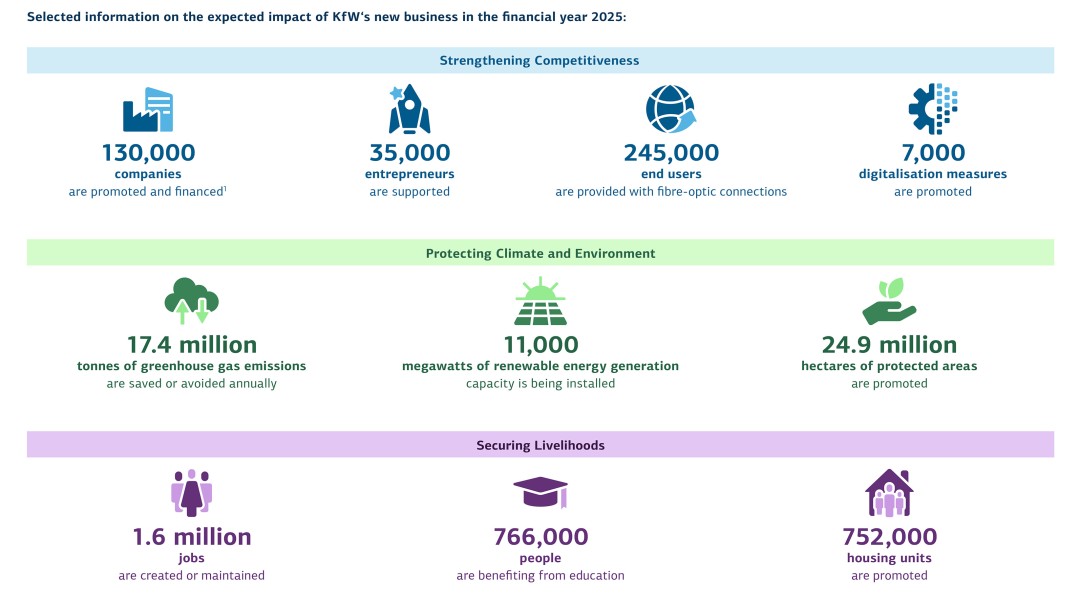
As valuable as impact management is, its implementation is equally challenging. One reason for this is different perspectives on the topic of 'impact'. As a promotional bank, KfW, for example, clearly focuses on new business and annually determines the expected impact of the financing and promotions committed in the respective financial year – such as the planned power generation output through the financing of a wind farm. However, the actual impact achieved can often only be measured years later – for example, when the wind farm has been completed and is ready to be put into operation.
Different impact measurements are used depending on the approach, which increases the demand for comprehensible communication. "This complexity makes it so important for us to disclose how we proceed and which assumptions and data our results are based on. This is the only way to avoid misunderstandings in interpretation," said Nina Zündorf.
In order to embrace this transparency, KfW has established annual reporting with its Impact Insights.
The Impact Insights, first published in 2025, enable stakeholders to understand the results achieved with KfW’s funds. In this way, KfW not only increases transparency, but also strengthens the debate on impact measurement in Germany. In line with its current strategic direction, KfW Impact Insights for the 2025 financial year place a special focus on KfW's contribution to strengthening Germany’s competitiveness and is publishing a series of impact indicators to support this. Furthermore, selected indicators highlight KfW’s influence on protecting the climate and environment and securing our livelihoods.

Share page
To share the current page content with your network, click the button below and then select the desired option in the dialog box.
Note on data protection: By clicking the button, your browser's sharing function is used. If you select an external provider when sharing, personal data may be processed by the provider. Please read our data protection principles for more information.
Your browser does not support sharing with external services.
Alternatively, you can also copy the short link: https://www.kfw.de/s/ennB_q1f
Copy link Link copied