The Germany Fund
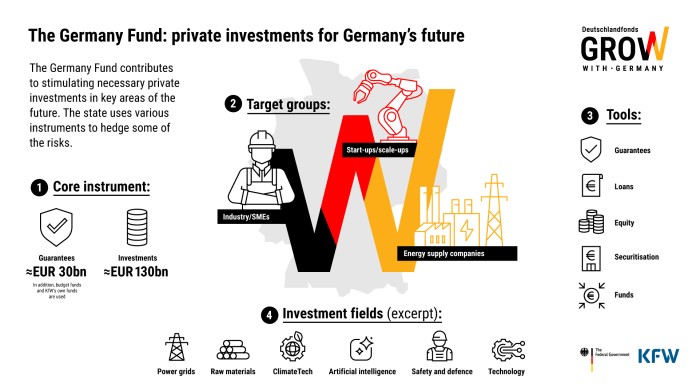
Private investment for Germany's futureThe Germany Fund creates a framework that makes it easier for private and municipal companies to invest in Germany on a large scale. The federal government is providing public funds and guarantees amounting to around EUR 30 billion for this purpose. This is intended to trigger total investments of around EUR 130 billion – as an investment offensive alongside the special government fund. KfW is coordinating the Germany Fund and is the point of contact for national and international investor advice.
The key areas in which the Germany Fund is intended to stimulate private investment are industry and small and medium-sized enterprises, venture capital, and energy infrastructure. These include, for example, major future investments in new technologies and production facilities, the expansion of renewable energies, heating networks, and electricity grids, but also the extraction of raw materials and the financing of innovative technologies in the fields of deep tech, AI, and biotech, as well as the development of solutions to strengthen defense capabilities.
The Germany Fund, launched in December 2025, has got off to a successful start. The Germany Fund was established to mobilise private capital for future-oriented investments and thereby boost the competitiveness of the German economy. Private investment is a key factor in driving growth in Germany. The Deutschlandfonds aims to channel private capital to where innovation takes place and growth is possible. To this end, it uses a range of instruments to specifically address the needs of industry, small and medium-sized enterprises (SMEs), young companies, start-ups and scale-ups, as well as energy supply companies.
As a key measure by the Federal Government to mobilise private capital, the Germany Fund successfully initiated its first round of financing in the first six months, thereby enabling concrete private investment in important future-oriented sectors with the help of government incentives. Further projects and components are set to be launched. For the target group of start-ups and scale-ups, as well as the wider SME sector, the Federal Government and KfW are making a further total of EUR 1.5 billion available over the next ten years.
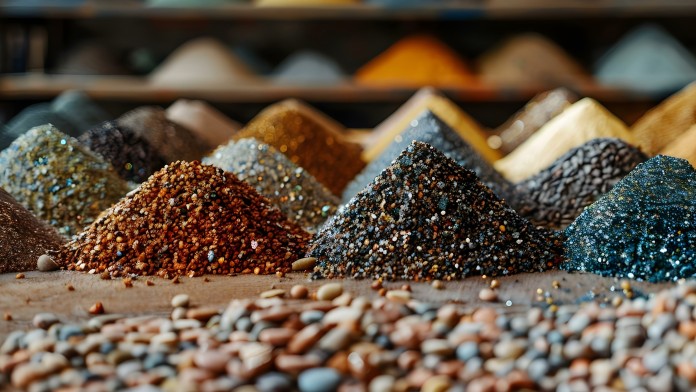
The Raw Materials Fund, as a component of the Germany Fund, has made investment decisions regarding two commodities projects for the extraction of rare earths and lithium. In addition, investments in German technology start-ups have been acquired under the umbrella of the Germany Fund. The securitisation module aimed at improving the supply of credit to small and medium-sized enterprises has also been launched; the first guarantee-backed financing arrangements for the production of transformation technologies are planned for the near future. Further specific projects are in the pipeline: for instance, work has begun on the design of “MittelstandsKapital” (SME Capital), which is due to launch in autumn 2027, whilst in the energy sector, three new components of the Germany Fund are about to be launched. Furthermore, the new venture capital programme “WIN 400” is already up and running as of today.
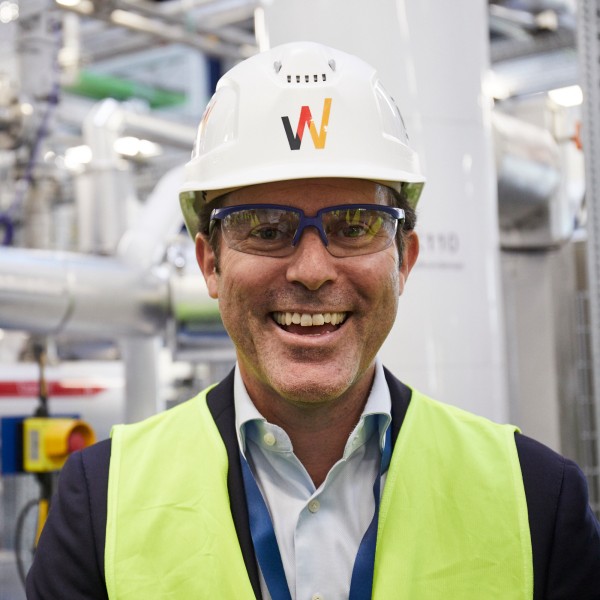
“The first six months since its launch show that the Germany Fund is driving investment in and for our country. At KfW, we will analyse the lessons learnt from the first projects together with the Federal Government and use them to further develop the Germany Fund – so that these initial successes can help to strengthen a sustainable investment momentum for Germany. Our aim remains, above all, to stimulate private investment – including through new financing instruments.”
The financing options offered by the Germany Fund are to be used by industrial companies, medium-sized companies, start-ups, young growth companies, private and municipal energy suppliers, and companies in the defense and raw materials industries. In order to address the entire spectrum of needs, the Germany Fund is not an investment fund, but rather an umbrella structure for various target groups that specifically address these needs.
The Germany Fund facilitates the financing of future investments in competitiveness for the target group of industry and small and medium-sized enterprises. This includes the hedging instrument for transformation industries, which supports large-scale investments by industry, for example in the areas of power generation or hydrogen, but also in the automotive industry, among small and medium-sized suppliers, and in mechanical engineering. The Raw Materials Fund provides KfW equity investments and loans to finance projects for the extraction of critical raw materials for the German economy, such as the promotion of lithium extraction in Germany.
Example: A company invests in the expansion of battery storage facilities. KfW, together with banking partners, secures the delivery of the facilities with a guarantee. This enables the company to increase its investment volume.
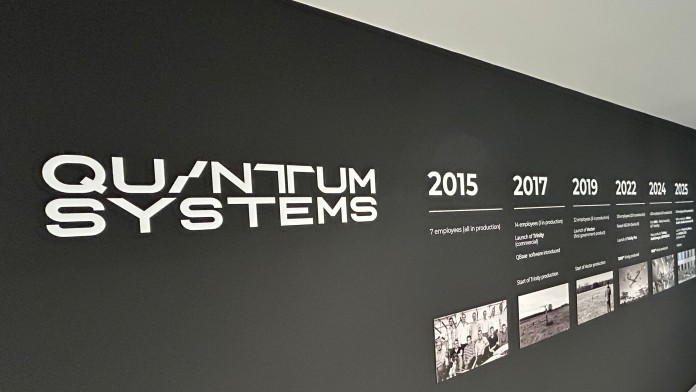
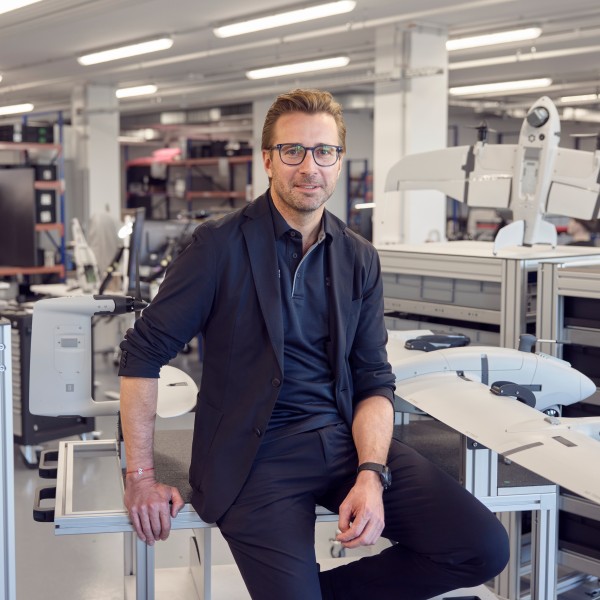
Under the umbrella of the Germany Fund, the dual-use scale-up Quantum Systems, based in Gilching near Munich, received its first investment commitment in mid-December 2025 and its second in July 2026 from KfW Capital’s Scale-up Direct programme, in collaboration with general partner HV Capital.
Scale-up Direct is a new, additional source of capital for innovative, high-growth technology companies. It enables direct co-investments to bolster funding rounds — with up to EUR 50 million per company. The requirement is that, in addition to the general partners from the KfW Capital portfolio, a private investor must participate in the round. A total of EUR 1 billion is earmarked for Scale-up Direct through 2030.
KfW Capital, together with portfolio partner UVC Partners, has invested in Isar Aerospace through the Scale-up Direct programme. The investment is part of the venture capital pillar of the Germany Fund and represents KfW Capital’s next direct co-investment under the new programme.
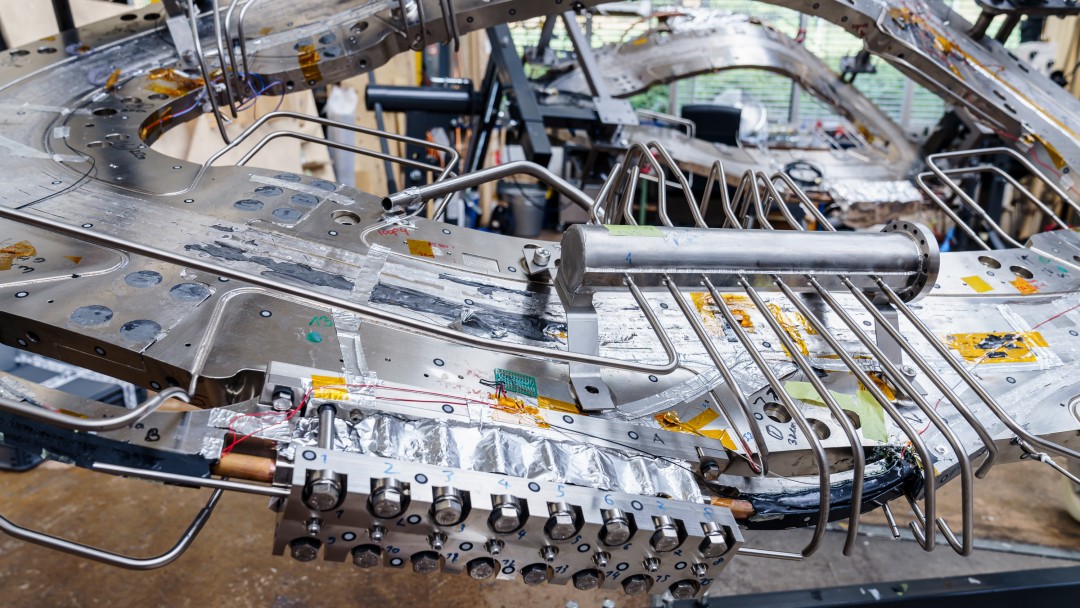
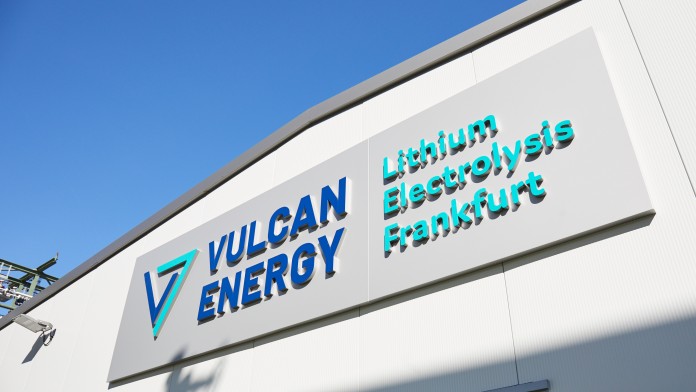
The Raw Materials Fund, under the umbrella of the Germany Fund, is investing up to EUR 150 million in the implementation of the ambitious Lionheart project by the German-Australian company Vulcan Energy in the Upper Rhine Rift and in Frankfurt-Höchst (Hesse), thereby helping to strengthen the resilience of European and German raw materials supplies.
As part of the project, lithium - a key material for electric vehicle battery production - will be extracted from geothermal brine in the vicinity of Landau (Rhineland-Palatinate). At the same time, construction of a large-scale lithium plant in the Frankfurt-Höchst Industrial Park will begin in April 2026. On a site covering approximately 80,000 square meters, an existing facility will be expanded to include a second production plant and a battery storage facility with a capacity of 18–22 MWh.
Together with the combined geothermal and lithium extraction plant in Landau, this will create Germany’s first sustainable lithium supply chain - efficient, regional, and forward-looking. Once completed, batteries for approximately half a million electric vehicles will be manufactured annually in Frankfurt-Höchst.
This is a significant step toward Germany and Europe’s independence from raw materials—with support from the Federal Government’s Germany Fund and KfW.
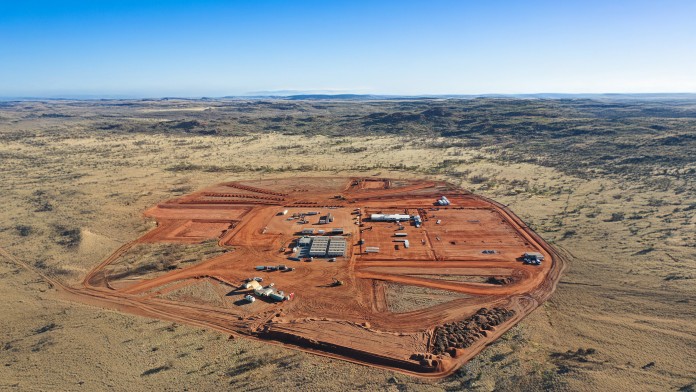
Through the Raw Materials Fund, the German Government is investing up to 50 million euros in the Nolans project run by the Australian company Arafura Rare Earths Ltd. in the Northern Territory. In doing so, it is strengthening the secure and diversified supply of critical rare earths to Germany and Europe and reducing existing dependencies.
The project focuses in particular on the rare earths neodymium and praseodymium. These are key precursors for high-performance permanent magnets, which are used, amongst other things, in electric vehicles and in onshore and offshore wind turbines. The development of additional extraction and processing capacities outside existing concentrations is a key element in enhancing the resilience of global supply chains.
The Germany Fund brings together various measures designed to mobilize private capital for investment in Germany. This is achieved, for example, through government risk protection for financing the energy transition, or through government-backed investments in raw materials projects, venture capital funds, or start-ups. Accordingly, the Germany Fund is not a fund in the traditional sense. The focus is on three target groups: energy supply companies, industry/SMEs, and start-ups and scale-ups.
As of 15 July 2026
Share page
To share the current page content with your network, click the button below and then select the desired option in the dialog box.
Note on data protection: By clicking the button, your browser's sharing function is used. If you select an external provider when sharing, personal data may be processed by the provider. Please read our data protection principles for more information.
Your browser does not support sharing with external services.
Alternatively, you can also copy the short link: https://www.kfw.de/s/enkB8aSA
Copy link Link copied