
Tip: Activate javascript to be able to use all functions of our website
Tip: Activate javascript to be able to use all functions of our website

KfW Research
30th Climate Change Conference (COP30)Ten years after the Paris Agreement, the world is heading for global warming well above the the target of 1.5 degrees. As the effects of climate change become increasingly apparent, the benefits of climate protection measures are also coming into focus, from avoiding climate damage to participating in green markets of the future. The 30th Conference of the Parties of the UNFCCC (COP30) in Belém, Brazil, highlights the new national commitments of countries – and the widening gap in achieving long-term goals. In the midst of geopolitical uncertainty, it will now be crucial to put plans into action with concrete strategies.
In addition to renewing the climate plans of the signatory states, the NDCs (Nationally Determined Contributions), it is also important to address the implementation of the financing target for climate protection and adaptation in developing countries that was adopted last year. The host Amazon region also puts the focus on forest and biodiversity protection and the role of indigenous peoples. Against the backdrop of a challenging geopolitical situation, the participating countries face major challenges – but also opportunities – at the climate conference.
Two new studies by KfW Research in collaboration with Deloitte and the Potsdam Institute for Climate Impact Research (PIK), respectively, address the opportunities offered by climate protection through innovation and technology and the importance of international cooperation in times of geopolitical fragmentation:
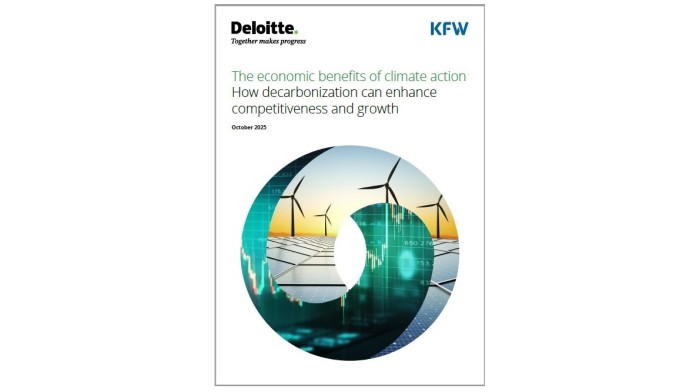
Climate action creates opportunities for competitiveness and resilience for companies, as shown by a study from KfW Research and Deloitte. The global market for clean technologies is growing rapidly and, if current trends continue, will double in less than ten years. In Germany, the clean technology sectors are well positioned, accounting for 13% of global green tech exports. Through ambitious climate action, companies can also benefit from a better risk position and greater resilience due to reduced dependence on volatile energy and CO₂ prices, from cost savings thanks to falling prices for renewable energy and storage, as well as from favorable financing opportunities in light of regulatory requirements and growing interest in sustainable investments. In the short term, however, some challenges must be overcome. The study recommends targeted economic policy measures to ensure that these opportunities can be realized.
The economic benefits of climate action – How decarbonization can enhance competitiveness and growth
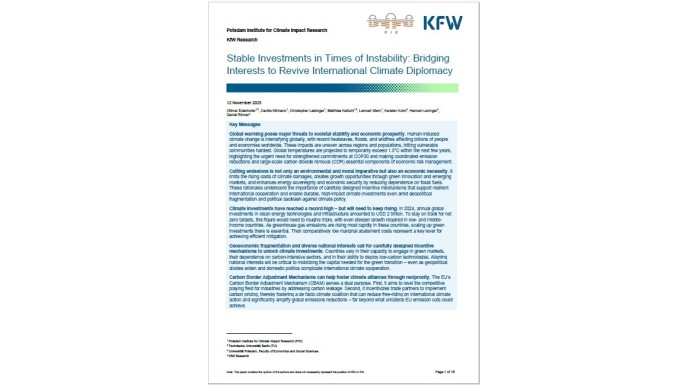
The international community is facing a shrinking budget for greenhouse gas emissions in order to limit global warming to 1.5 degrees Celsius and, at the same time, a rise in geoeconomic fragmentation. A joint discussion paper by PIK and KfW Research emphasizes the advantages of international climate protection by preventing climate damage, promoting innovation and growth in green technologies, and reducing dependence on fossil fuels. Current climate investments must triple in order to achieve the Paris climate targets. The required increase is even higher in low- and middle-income countries, where access to capital is constrained. Against this backdrop, mechanisms that ensure reciprocity and efficient distribution of available funds are key. Starting points include a border adjustment mechanism for CO2 and “minilateral” alliances for coordinated climate investments.
November 2025
KfW Research, KfW Group, Palmengartenstrasse 5-9, 60325 Frankfurt, Germany,
Share page
To share the current page content with your network, click the button below and then select the desired option in the dialog box.
Note on data protection: By clicking the button, your browser's sharing function is used. If you select an external provider when sharing, personal data may be processed by the provider. Please read our data protection principles for more information.
Your browser does not support sharing with external services.
Alternatively, you can also copy the short link: https://www.kfw.de/s/enkB82aE
Copy link Link copied