Tip: Activate javascript to be able to use all functions of our website
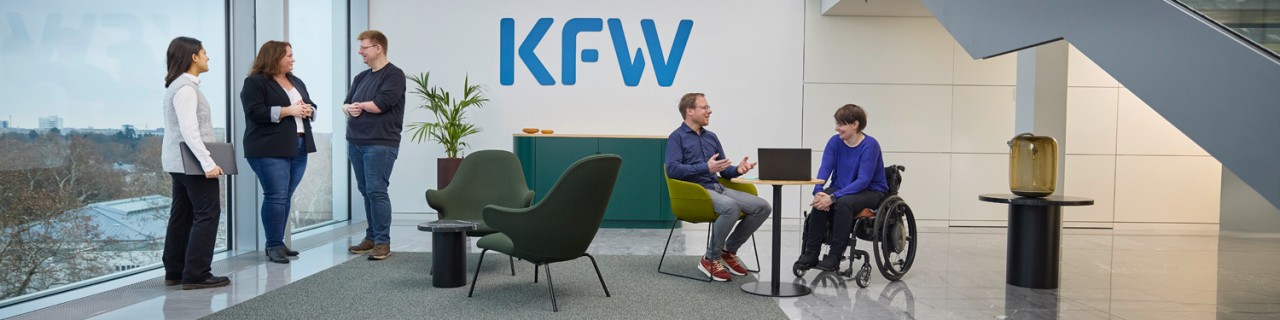
As a bank committed to social responsibility, KfW stands for fairness and respect in the workplace. Here, you’ll find an open and trusting working environment where we actively embrace diversity and inclusion. After all, groundbreaking ideas emerge only where many different perspectives come together.
We are committed to ensuring that everyone has equal opportunities and to fostering an environment where diversity is valued and everyone can reach their full potential.
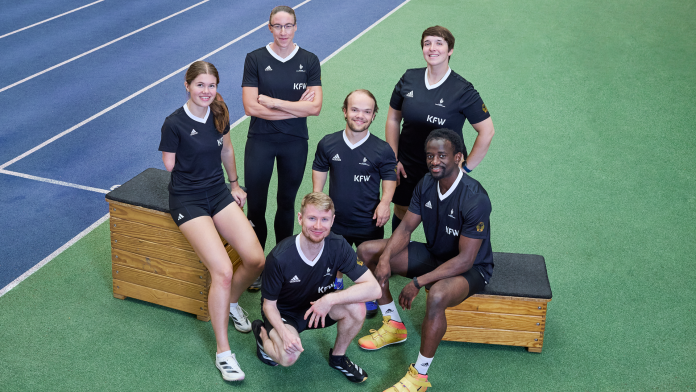
As an inclusive employer, we are very pleased to continue the partnership with the DBS, which has been existing since 2021, and to be actively involved in 2025–26 as the proud main sponsor of the German national Para Athletics team. The German Disabled Sports Association is one of the world’s largest sports federations for people with disabilities. The aim is not only to ensure accessibility, but also to include people with disabilities as equal members of society. We want to consider, live, and promote participation and inclusion beyond sport – especially in everyday working life.
With our new campaign “Because they can,” we are making visible what inclusion means to us: creating opportunities, fostering potential, and supporting people along their journey. At the centre are para-athletes in track and field who pursue and achieve their goals with passion, talent and determination – because they can, and because others believe in them. As KfW, we are committed not only to valuing inclusion, but to actively promoting it – in sports, in professional life and in society.
We are very pleased to support the German national Para Athletics team in 2025–26 as their proud main sponsor.
This sponsorship is a matter close to our hearts – through our commitment, we want to help break down barriers and increase the visibility of para sports. The diversity within para-athletics in particular shows that people with very different starting points, driven by their passion and perseverance, consistently deliver impressive performances. The athletes inspire us through their dedication, teamwork and fighting spirit. They are not only role models in sport, but also ambassadors for an inclusive society that values and promotes diversity.
In 2024, together with the DBS, we launched a large-scale campaign focusing on inclusion in sports and the workplace – together we are committed to ensuring that every individual can successfully develop their own strengths.
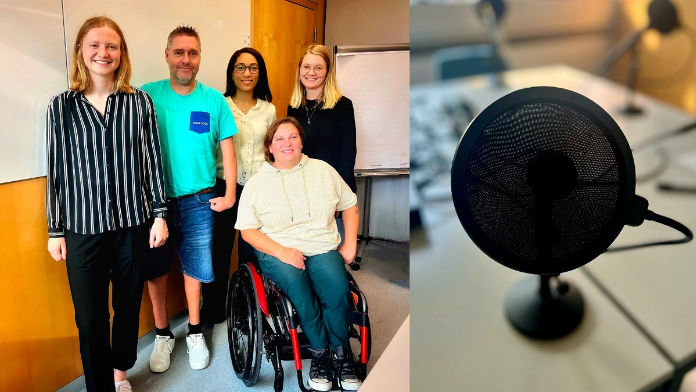
2024 is a big year with major international competitions for parasport. To ensure that inclusion does not stop at sports but also becomes part of everyday (working) life, the second episode of the new KfW podcast “Richtig Zugehört (Listened carefully) ” not only offers a behind-the-scenes look at German parasport, but also addresses important questions that inclusion poses for companies and what people without disabilities can do to contribute to an inclusive working environment.
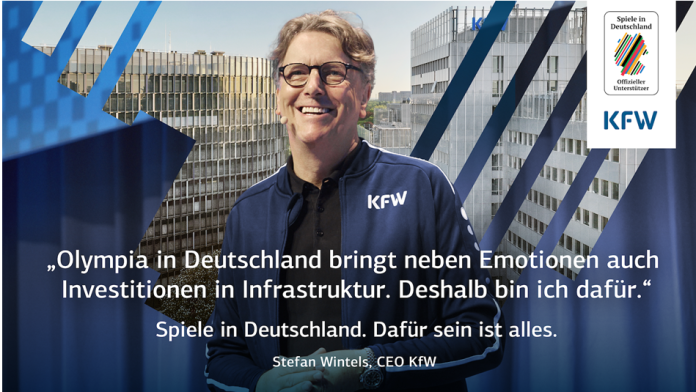
KfW stands for forward-looking investments, sustainable development and social commitment. In line with our thematic focus on “Inclusion in sports and at work” and our sponsorship of the German national para athletics team, KfW is now also actively involved as part of the business initiative “Dafür sein ist alles (Taking part is everything)” in support of the Olympic and Paralympic Summer Games in Germany. The initiative presents Germany as an open and welcoming country with strong values that are also central guiding principles for us at KfW. As an inclusive employer, KfW is committed every day to embracing diversity and creating equal opportunities for all employees. Cohesion and openness shape our corporate culture, in which everyone is welcome to help shape the future together.
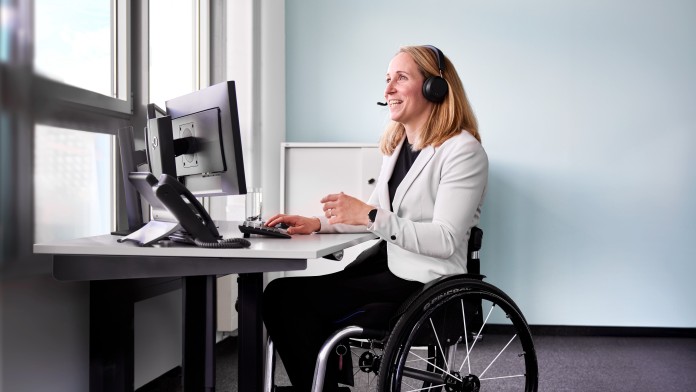
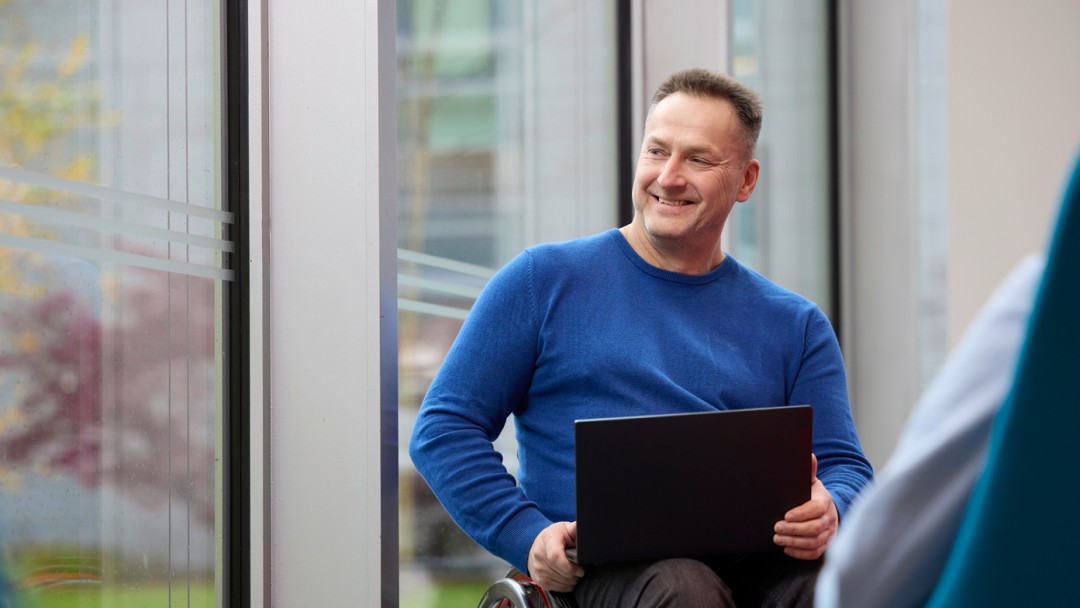
"As a wheelchair user, physical accessibility—especially access to buildings and rooms—is of great importance to me. Thanks to ground-level entrances and an adequate number of elevators, getting around in a wheelchair at KfW is never a problem for me. Although I sometimes have to take small detours due to differences in elevation between buildings, that doesn’t bother me because I know I can ultimately reach all rooms. It’s also important to me that accessible restrooms are available everywhere, and these are indeed available in all KfW buildings. Overall, I feel very comfortable here and appreciate the positive atmosphere, which allows me to participate fully."
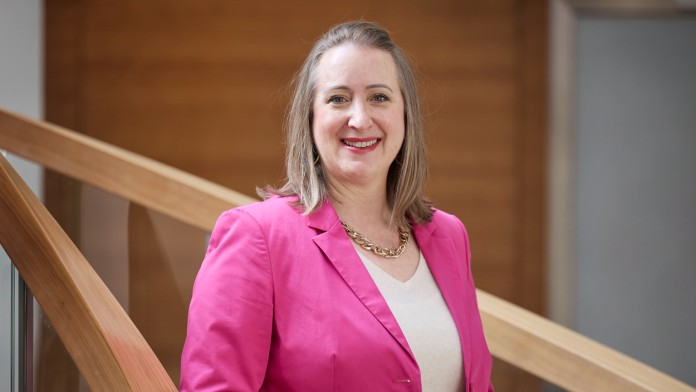
"As a passionate recruiter, I value direct interaction with people with disabilities to learn about their unique skills. Specialised job boards, relevant events, and collaboration with supportive organizations help me establish initial direct contact with this target group. During the selection process, I place great importance on taking individual needs into account and creating an inclusive environment where everyone is treated as equals. Asking about necessary assistive devices, well-being, or the work environment is second nature to me. In my role, I can play a decisive part in shaping an inclusive corporate culture. That motivates me and gives my work additional meaning."
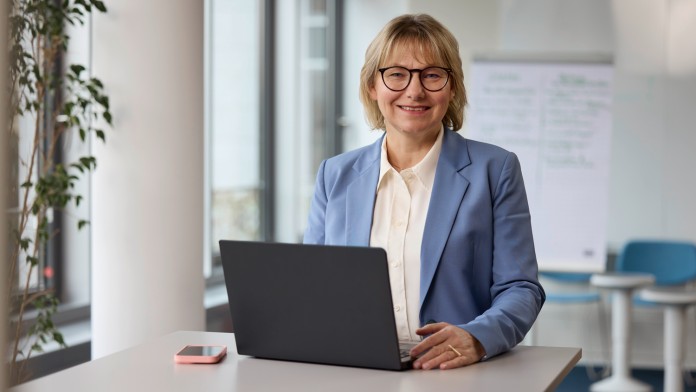
"For KfW, inclusion is a central component of our corporate culture. We value the diversity of our employees’ experiences and skills and are committed to creating a work environment where every person is respected and valued. That is why we encourage dialogue, offer jobs tailored to individual needs, and are constantly expanding our network. We are convinced that shared success is only possible in an open and team-oriented environment."
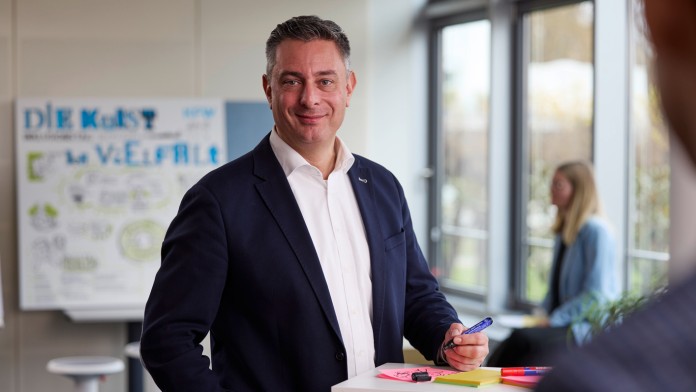
"In my view, KfW is well-positioned when it comes to inclusion awareness and the inclusion of people with disabilities. Inclusion is an ongoing process. The idea must first take root in people’s minds before it can be put into practice. As someone with a disability myself, I have a natural motivation to advocate for the interests of my colleagues. I am pleased with the positive developments we’ve seen recently, which show that we are on the right track. I am proud to be a voice for so many employees.”
Sports have always been central to my life: Even as a child, I was able to try out various sports regularly, with soccer being my first passion. After school, I began an apprenticeship as a roofer, which I continued until my skiing accident in 1997. After rehabilitation, I decided to retrain as an IT specialist. Getting started in the profession after my accident was challenging: During my training, I often had to prove that it was possible to complete the program while in a wheelchair. I frequently heard people say, “That’s not possible as a wheelchair user.” The job search after I graduated also proved difficult at times; I sent out about 300 applications and often received immediate rejections or was turned down because of accessibility issues. After graduating, I initially took the plunge into self-employment and subsequently worked at a small company in Mainz.
I’ve always preferred ball sports, and after my accident, I started playing wheelchair basketball, tennis, and wheelchair rugby. What I especially like about wheelchair basketball is the dynamism, speed, and constant coordination with my teammates. Wheelchair rugby is more tactical and physically demanding, while tennis is simply a fun leisure activity for me. Some of my basketball teammates who worked at KfW recommended that I apply for a job there. Looking back, the people I’ve met through sports have always been there to help me. At KfW, I finally found an accessible and non-judgmental environment. Today, I look back on 20 years as a KfW employee: My career at KfW began in access control, which is now called “Identity & Access Management.” That was classic user administration in a very pleasant team—we still go out for lunch together from time to time. After about 10 years, I had the opportunity to make an internal move and joined the Citrix team. Here, we administer Windows servers, provide employees with a wide range of applications, and operate the infrastructure (such as VPN, desktops, VDIs, and RSA) to ensure that work from home and in our international offices runs smoothly. These diverse areas of responsibility make the work varied and exciting; security issues can sometimes be very challenging, but that’s all part of the job.
Playing sports helps me take a step back from work and everyday problems. It clears my head and relieves tension. If I can’t train for a long time, I feel uneasy. I’ve learned important lessons from sports: To push your limits, you have to be willing to challenge yourself, never give up, and not let yourself get discouraged. I pursue my goals with determination, both in sports and at work. Balancing my job at KfW with my wheelchair basketball career has always been important to me. I didn’t want to give up either and found ways to combine the two. The flex-time policy and my team leader’s understanding, as well as my family’s support, play a crucial role in this.
I believe that people with disabilities are in good hands at KfW. Employees receive special workplace accommodations as needed and are supported when submitting applications to rehabilitation providers. But the most important thing for me is this: My disability is not—and has never been—an issue among my colleagues and supervisors. I’m a completely normal team member with all the pros and cons, if you can put it that way. My advice to people who, after a similar experience, are looking to find their way in their professional lives or in sports: Set goals for yourselves and work toward them. Don’t let others discourage you by telling you what you can’t do. Just give it a try and see, what could happen.
Some time ago, I decided to go public about my chronic illness—to serve as an example and source of inspiration for others. This has led to many positive outcomes.
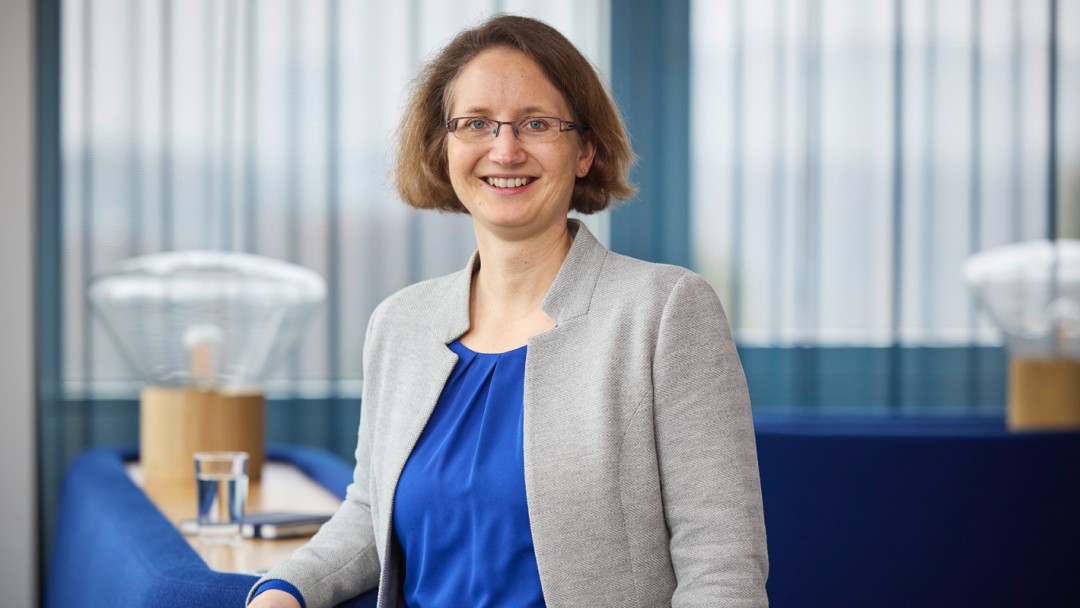
I have been working at KfW Development Bank since 2008, first as a project manager and later as a senior sector economist for urban water management in the Sector Policy Department. I enjoy my work; while it is very demanding, it is also very fulfilling. We deal with international issues and challenges for which there aren’t always simple solutions. This requires specialized knowledge on the one hand, and a spirit of innovation and creativity on the other. I have always found my work to be both challenging and meaningful. In short, I am a motivated employee and have always given it my all.
In 2017—at the time I was working in the Asia Division—I experienced a life-threatening health incident. This was not only very frightening for me personally, but also had physically traumatic consequences: Since then, my body has not been producing enough hormones. I need medication regularly, and a little more during stressful periods. As a result, I also need more time to recover than I used to.
After a prolonged period of illness and a return to work, I reduced my hours and—with strong support from my division manager at the time—transitioned from project management to the Sector Policy staff department. I wanted to continue meeting my high standards for my work, but decided to reduce my travel—a potential source of stress—for the time being. The transition worked out well. Through an extended coaching program, I also learned to be more open about my new situation.
Eventually, I had my chronic illness recognised as a disability. To do so, I had to overcome some internal barriers. But this process was worth it: It restored my self-confidence and showed me that there’s nothing wrong with me—I just need slightly different conditions in some cases—for example, a designated workspace and, with it, a quiet office.
That was two years ago; I’m now back on business trips. For a while, I’d believed the two were mutually exclusive, but that’s not true. For example, I represented KfW at a BMZ conference in Berlin—and took the stage right after Ministers Schulze and Lemke. Anything is possible if you arrange the circumstances accordingly and coordinate with your colleagues on the team. In this case, I needed enough time for travel to and from the event and some flexibility on the day of the conference, without having to be available at the same time. So, actually, not that much. It’s really all about the mindset. If inclusion is consistently taken into account, (almost) anything can be arranged. The conference went very well—everyone was satisfied, including me!
Looking back, I can say this: A great deal of positivity comes from people like me stepping forward. This opens up paths that we may not have seen before, but which show that things can be done and accomplished just as well—if not better—in different ways. Ultimately, the goal is to foster talent together and, with KfW as an inclusive employer, to continually blaze new trails.
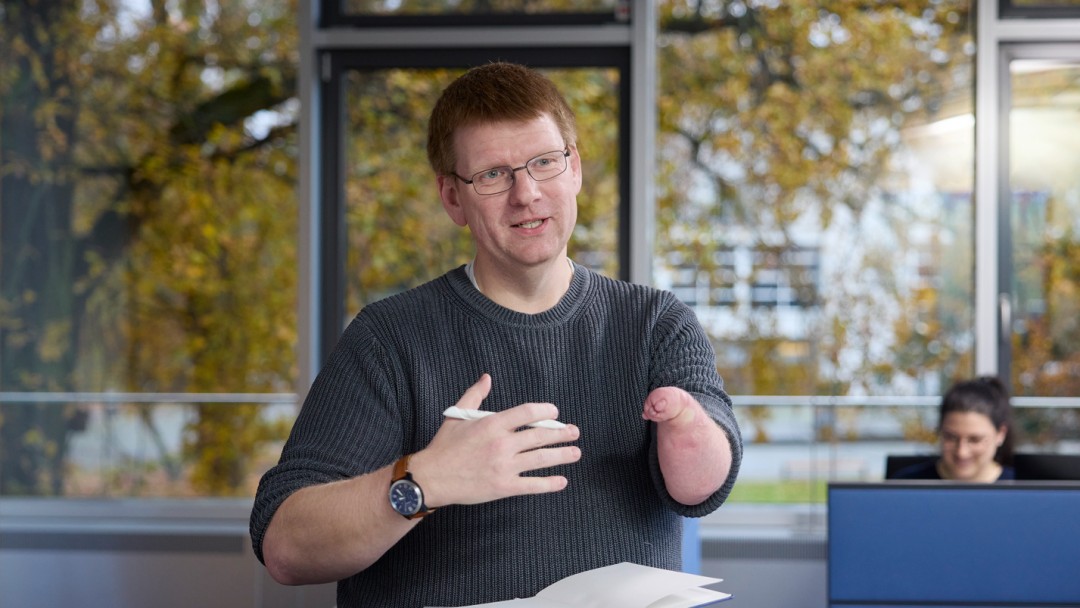
My name is Daniel Metz. I’ve been with KfW since October 2018, and I have a disability: I’m missing my left hand. But that has never stopped me from taking on challenges.
Since my parents wanted me to learn to swim, I joined the German Life Saving Association (DLRG) at the age of six. Over time, I passed all the tests, from the Seepferdchen to the Silver Lifesaving Badge. I also took part in the weekend seminars and camps offered by the DLRG Youth program. My disability was never an issue or an obstacle. True to the motto “The best way to learn is by doing,” I forged my own path. As a teenager, I began planning and running events for children and teens as a team leader, and later took on a position on the board of the DLRG Youth Frankfurt. I can honestly say I just grew into it. For my peers (in the late ’90s and early 2000s), my disability was never an issue that was particularly emphasised. It was simply a given that I would be there.
In addition to the DLRG, music plays an important role in my life. When I was about 11 years old, I started learning to play the trumpet at the Youth Music School in Frankfurt. After years of private lessons, I decided to join a music club that focuses primarily on the “Fifth Season” (Carnival). The transition was quite a big one at first—going from a “lone wolf” to a “team player,” or from a “seated musician” to someone who marches in parades. But it was the parades in particular that really pushed me forward. On the one hand, there was the physical exertion of marching while playing, but also the response from the audience, which kept driving me forward. Just as I had done with the DLRG, I actively involved myself in the club’s activities. I helped organize club parties and events where we showcased the club to the public. Here, too, it eventually became a matter of course for me to serve on the board as an active member. First as a board member, and later as chairman. And here, too, it was simply a given to be part of it—no ifs, ands, or buts. Whether it was adjusting my uniform (shortening the sleeves) or modifying an instrument (for a colleague who had suffered a stroke): “Can’t be done” wasn’t an option! Whatever could be done was done within the club.
So what does all this have to do with KfW and my work in HR? I’m happy to say that at KfW, I can always be myself—I was accepted without reservation right from the start. My disability doesn’t matter; instead, I’m valued for my performance. Through my positive experiences dealing with my disability since childhood, I, too, have learned to accept every person just as they are. That’s my strength. In my work in HR, I’m often the first point of contact between a wide variety of applicants and KfW. Whether it’s a trainee or an executive, it’s important to accept people unconditionally just as they are—and that’s exactly what I do!
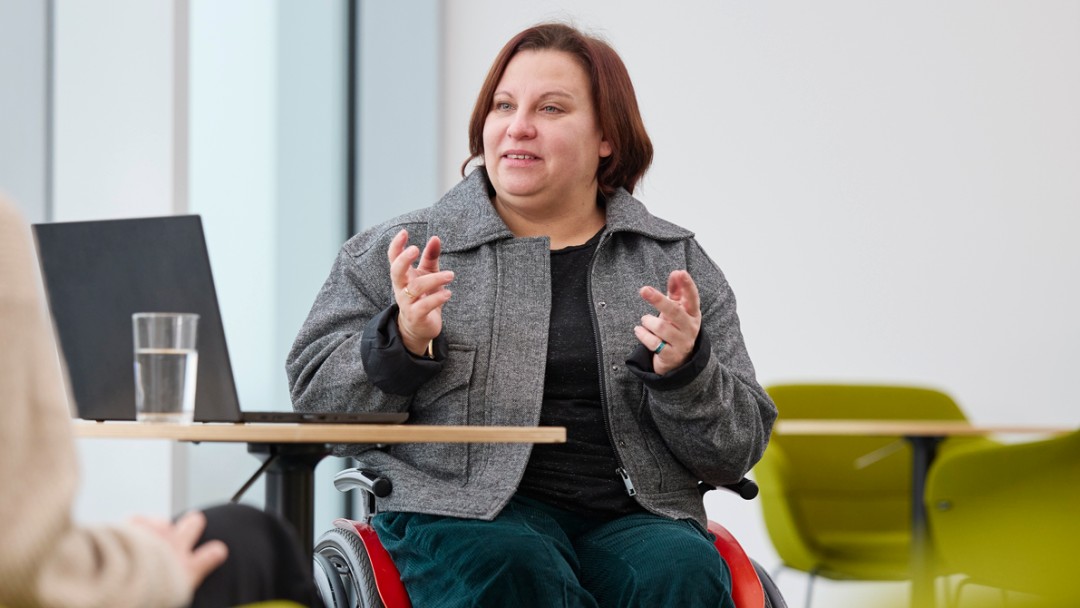
My name is Nora Schratz, and I have spina bifida, which means I use a wheelchair. In addition to my work at KfW as a human resources administrator on the HRd2 team, I was active in competitive sports for many years: I played on the German national wheelchair basketball team for over 10 years. After my playing career, I trained to become a coach and served as the national coach for the women’s U25 wheelchair basketball team from 2014 to 2019.
In fact, I joined KfW through connections I made during my athletic career. At the time, I was looking for an employer that would provide me with an accessible environment while also supporting my athletic career as a coach. According to what I’d heard, KfW was already an employer that promoted the hiring of people with disabilities and offered flexible working hours. In addition, I was able to take time off for the World Championship even during my probationary period—a clear sign of appreciation and inclusion. Since then, KfW and I have been a great team.
But what does this have to do with inclusion and KfW? Wheelchair basketball is currently one of the most inclusive sports I know. At the club level, teams include both able-bodied and disabled players, men and women, and people with a wide variety of disabilities. At KfW, there are also many different people with various disabilities or characteristics who must work together as a team. So I was fortunate to truly experience inclusion through this sport, even without always needing a specific label for it, and it also made me a team player—in all situations: When everyone takes a different perspective more often, there is much greater acceptance and tolerance. In my team, I’m fortunate that this happens frequently now, and I feel as though my disability is no longer visible. During team or department workshops, for example, people automatically make sure the environment is accessible, and my colleagues sit down at a table with me instead of standing at a high table.
For me, the most important thing is to simply ask when you’re unsure, and feel free to offer help, because there will never be a fully accessible world. I’ve found that it makes it easier for others to approach me when I’m open about my disability and clearly state where I need help—and where I don’t. This helps the other person better understand what’s important in the next situation, and just like that, a little bit of inclusion is created. And I’d like to commend my team and my department for this. I’m glad that this has actually happened.
In my experience, a team functions because of each individual’s strengths, and one shouldn’t focus on weaknesses. I think many people view a disability as a weakness. But I can only say for myself that my disability has fostered my strengths—such as speaking up, being open, trying to understand the other side, and—especially when it matters—not giving in. And I’m very grateful for my athletic career, as it has greatly strengthened my self-confidence and helped me develop these qualities. Of course, this has also had a positive impact on my professional career. After all, these qualities are highly valued by my managers and colleagues at work.
I think it’s great that I’m constantly given the opportunity to work on the issue of inclusion across departments and divisions. For me, this is a crucial factor in truly creating an inclusive environment. I can only keep urging people with disabilities: “Be visible whenever you can.” There are many of us, and this is the only way we can bring about change—because there is still a lot to be done.”
After more than 20 years in research and teaching, and later as the managing director of a medium-sized company, I was looking for a new career path that would better suit my health situation. I live with epilepsy, an invisible disability. People with disabilities are often hastily perceived as unable to handle stress or as complicated. This idea has stayed with me for a long time, and it’s one of the reasons why I want to share my experience.
I got in touch with KfW through myAbility’s talent programme. The open dialogue with KfW’s recruiters and a subsequent three-day job shadowing experience quickly showed me that openness is possible here. Thanks to the close contact with my future team leader, it was easier for me to build trust and remain transparent about my disability.
For the first time in my entire career, I disclosed my disability at work. I explained my situation and potential risks, and the team responded thoughtfully. Some colleagues took a first-aid course, while others spoke openly for the first time about their own health challenges.
For me, that was a moment of realization: openness does require courage, but it also gives you strength. For the first time, I was able to work without the constant cognitive effort of hiding my situation. That frees up energy – for me and for the team. Of course, questions remain: How will I be perceived in the future? Will people see me beyond my disability? How will my disability affect my career in the long term? But my experience at KfW makes me optimistic.
I have also seen how the presence of people with special needs can have a lasting impact on a team. It makes everyone more aware that each person has their own need for support, their own limits and insecurities. When these things can be spoken about openly, trust grows, and a work culture emerges that is more human and at the same time stronger. I am pleased to be part of KfW and to actively contribute to a culture of lived inclusion.
As part of our recruiting activities, we therefore offer people with disabilities the exclusive opportunity to submit an unsolicited application. If any aids or adjustments are needed during the application process, we will of course be happy to provide them. Our HR contacts are also personally available for any questions or requests – both during the application process and later in everyday working life.
As part of our recruitment process, we therefore offer people with disabilities the exclusive opportunity to submit a speculative application. If any assistive devices are needed during the application process, we will of course be happy to provide them. Our HR representatives are also available in person to answer any questions and address any requests—both during the application process and later in day-to-day work.
KfW offers attractive and diverse employment opportunities.
For people with a severe disability, there is also the option of submitting an unsolicited application.
Contact option on the topic of inclusion:
Share page
To share the current page content with your network, click the button below and then select the desired option in the dialog box.
Note on data protection: By clicking the button, your browser's sharing function is used. If you select an external provider when sharing, personal data may be processed by the provider. Please read our data protection principles for more information.
Your browser does not support sharing with external services.
Alternatively, you can also copy the short link: https://www.kfw.de/s/enkBbwue
Copy link Link copied